shinnku's Blog

Online Matching with Stochastic Rewards

By shinnku on Oct 23, 2025
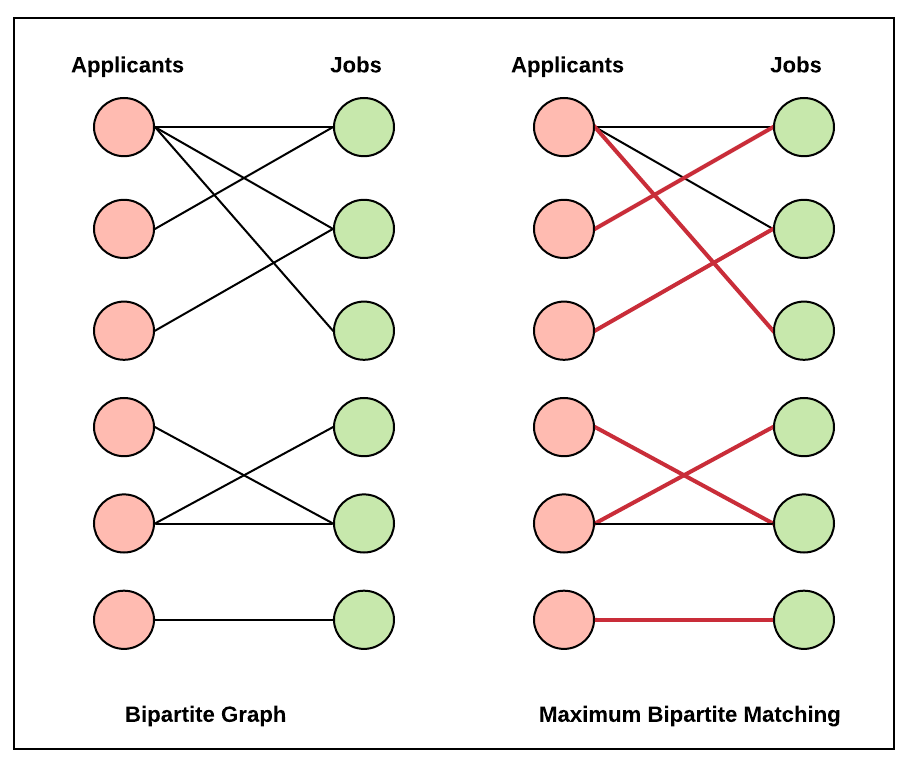
A bipartite graph representation

Setting & model

Online Bipartite Matching

The author Karp, Vazirani, and Vazirani introduce a bipartite graph model G=(UV,E)G =(U \cup V, E), where UU is given offline and VV arrives online [KVV90]. The online algorithm must irrevocably match each arriving vertex vVv \in V to an unmatched neighbor in UU or leave it unmatched.

The offline optimal is defined as the maximum matching in GG. The competitive ratio is defined as the expected size of the matching produced by the online algorithm divided by the size of the offline optimal matching.

Ratio=ALG/OPTRatio = ALG / OPT

Online Stochastic Matching Problem

In the online matching problem with stochastic rewards, every edge (u,v)(u, v) also has an associated probability of success puvp_{uv}.

When a new vertex vVv \in V arrives online, the algorithm either chooses not to assign it at all, or assigns it to one of its neighbors (these are the available options).

If vv is assigned to uUu \in U using the edge (u,v)(u, v), a Bernoulli experiment is performed and the edge (u,v)(u, v) becomes a successful assignment with probability puvp_{uv}.

In successful assignment case, we say that uu was successful and remove it from the set of available vertices. On the other hand, if the assignment (u,v)(u, v) is not successful, uu remains available and a neighbor of uu that arrives later in the online order can be assigned to uu (but vv cannot be assigned in the future).

The overall objective is to maximize the expected number of successful vertices uUu \in U, or equivalently, the expected number of successful assignments.

Vertex-Weighted Stochastic Matching

In the vertex-weighted variant, each offline vertex uUu \in U has a nonnegative weight wuw_u. A successful assignment on uu yields reward wuw_u and removes uu from availability (as before). The objective becomes maximizing the expected total weight of successful offline vertices:

maxE[uUwu1{u is matched successfully}].\max \mathbb{E} \left[\sum_{u \in U} w_u \cdot \mathbf{1}\{u\ \text{is matched successfully}\}\right].

The unweighted model is the special case wu1w_u \equiv 1.

The four probability regimes below (Vanishing/Arbitrary × Equal/Unequal) remain the same; results in recent work typically extend to the vertex-weighted case with essentially the same analyses.

Probability Settings

  1. Vanishing & Equal Probabilities
  2. Vanishing & Unequal Probabilities
  3. Arbitrary/Non-Vanishing & Equal Probabilities
  4. Arbitrary/Non-Vanishing & Unequal

Offline Optimal Benchmark

The Budgeted Allocation Problem

Let G=(UV,E)G = (U \cup V, E) be a bipartite graph where edge (u,v)(u, v) has weight puvp_{uv}. For every vertex vVv \in V, we assign it to one its neighbors uUu \in U using edge (u,v)(u, v). The load LuL_u on a vertex uUu \in U is defined as the sum of weights of assigned edges incident on uu. The objective is to maximize uUmin(Lu,1)\sum_{u \in U} \min(L_u, 1).

For technical reasons, we allow fractional solutions, i.e. vertex vVv \in V can be assigned to its neighbors uUu \in U with fractions xuvx_{uv} subject to uUxuv1\sum_{u \in U} x_{uv} \le 1; then Lu=uUxuvpuvL_u = \sum_{u \in U} x_{uv} p_{uv}.

For any instance of the Online Stochastic Matching problem, we define OPTOPT to be the optimum fractional solution for the corresponding Budgeted Allocation problem. The next lemma claims that the value of OPTOPT is at least the expected number of successes obtained by any Online Stochastic Matching algorithm.

Distribution of the Success Threshold (Ө)

Let τ\tau be the round of the first success when repeatedly attempting the same offline vertex uu. Then

τGeom(p)(τ=1,2,3,).\tau \sim \operatorname{Geom}(p) \quad(\tau=1,2,3, \ldots) .

Measure “load” as the cumulative success probability: each attempt adds pp. Define

Θ:=pτ.\Theta:=p \cdot \tau .

Hence,

Pr[Θ=tp]=p(1p)t1(t=1,2,)\operatorname{Pr}[\Theta=t p]=p(1-p)^{t-1} \quad(t=1,2, \ldots)

so Θ\Theta only takes values in {p,2p,3p,}\{p, 2 p, 3 p, \ldots\}. A vertex uu becomes successful the first time its accumulated load u\ell_u reaches or exceeds Θ\Theta. This is exactly the “equivalent threshold view” used by Mehta-Panigrahi.

Basic moments. E[Θ]=1\mathbb{E}[\Theta]=1 and Var(Θ)=1p\operatorname{Var}(\Theta)=1-p. Thus, as p0p \rightarrow 0, both the mean and the variance tend to 1.

Vanishing limit (p0)(p \rightarrow 0). Viewing the discrete distribution as a continuous-load approximation,

Pr[Θ>x]=(1p)x/pp0ex\operatorname{Pr}[\Theta>x]=(1-p)^{\lfloor x / p\rfloor} \underset{p \rightarrow 0}{\longrightarrow} e^{-x}

i.e., ΘExp(1)\Theta \Rightarrow \operatorname{Exp}(1). Consequently, in small-pp analyses it is standard to model each offline vertex’s threshold as an independent Exp(1)\operatorname{Exp}(1) random variable.

Unequal but small probabilities. If the edge success probabilities puvp_{u v} differ but are all small, we still measure load as the sum of allocated success probabilities. In this continuous-load coordinate, the threshold is well-approximated by Exp(1)\operatorname{Exp}(1); each attempt just increments the load by the corresponding puvp_{u v} instead of a fixed pp.

Definition of Competitive Ratio

Let NuN_u denote the set of neighbors of an offline vertex uu.

For the unweighted case, the competitive ratio is E[ALG]/OPT\mathbb{E}[ALG]/OPT.

For the vertex-weighted case, the competitive ratio is E[ALGw]/OPTw\mathbb{E}[ALG_w]/OPT_w.

A convenient upper bound/benchmark is the (configuration) LP relaxation; a simple edge-based LP that suffices for exposition is:

maxuUwupuvxuvs.t.vN(u)puvxuv1uU(1)uN(v)xuv1vV(2)0xuv\begin{aligned} \max \quad & \sum_{u \in U} w_u\cdot p_{uv} \cdot x_{uv} \\ \text{s.t.}\quad & \sum_{v \in N(u)} p_{uv}\, x_{uv} \le 1 \qquad && \forall u \in U && (1) \\ & \sum_{u \in N(v)} x_{uv} \le 1 \qquad && \forall v \in V && (2) \\ & 0 \le x_{uv} \end{aligned}

Here xuvx_{uv} is the (fractional) probability of attempting (u,v)(u,v), all wu1w_u\equiv 1 recovers the unweighted benchmark.

Eqn. (1) states that the expected load of each offline vertex uu is upper bounded by 1, because it is upper bounded by the expectation of the threshold θu\theta_u, which equals 1. (this uses the Law of Total Probability)

Eqn. (2) is a standard capacity constraint: each online vertex vv can be matched to at most one offline neighbor.

Following the vertex-weighted model of Mehta and Panigrahi [24], we will consider the optimal objective of the above LP relaxation as the benchmark.

Configuration LP

For any SNuS \subseteq N_u, let pu(S)=min{vSpuv,1}p_u(S)= \min \left\{\sum_{v \in S} p_{u v}, 1\right\}. Consider the following offline-side configuration LP:

ConfigLP:maxuUSNuwupu(S)xuSs.t.SNuxuS1uUuUSNu:vSxuS1vVxuS0uU,SNu\begin{aligned} \text{ConfigLP:} \quad \max \quad & \sum_{u \in U} \sum_{S \subseteq N_u} w_u \cdot p_u(S) \cdot x_{u S} \\ \text{s.t.} \quad & \sum_{S \subseteq N_u} x_{u S} \leq 1 && \forall u \in U \\ & \sum_{u \in U} \sum_{S \subseteq N_u: v \in S} x_{u S} \leq 1 && \forall v \in V \\ & x_{u S} \geq 0 && \forall u \in U, \forall S \subseteq N_u \end{aligned}

From an offline optimization viewpoint, as pp, the upper bound of success probabilities, tends to zero, the configuration LP is equivalent to the standard matching LP in the following sense. First, the matching LP can be reinterpreted as to maximize

uUwumin{v:(u,v)Epuvxuv,1}\sum_{u \in U} w_u \cdot \min \left\{\sum_{v:(u, v) \in E} p_{u v} x_{u v}, 1\right\}

subject to only Eqn. (2) and (3).

On one hand, any feasible assignment of the configuration LP corresponds to a feasible assignment of the matching LP with

xuv=SNu:vSxuS.x_{u v}=\sum_{S \in N_u: v \in S} x_{u S}.

Comparing the objectives of the LPs, the matching LP objective is weakly larger because min{z,1}\min \{z, 1\} is concave.

On the other hand, given any feasible assignment of the matching LP, we can sample an integral matching via independent rounding, i.e., match each online vertex vv to a neighbor that is independently sampled according to xuvx_{u v} ‘s.

Then, it gives an integral assignment of the configuration LP: xuS=1x_{u S}=1 for the subset SS of neighbors matched to uu in the independent rounding, and 0 otherwise. Further, by standard concentration inequalities (and union bound), the load of each vertex uu is at most its expected load, which is at most 1 due to Eqn. (1), plus an additive error that diminishes as pp tends to zero. Hence, the optimal of the configuration LP is at least that of the matching LP less a term that diminishes as pp tends to zero.

The corresponding dual LP of the configuration LP is the following:

Dual:minuUαu+vVβvs.t.αu+vSβvwupu(S)uU,SNuαu,βv0uU,vV\begin{aligned} \text{Dual:} \quad \min \quad & \sum_{u \in U} \alpha_u+\sum_{v \in V} \beta_v \\ \text{s.t.} \quad & \alpha_u+\sum_{v \in S} \beta_v \geq w_u \cdot p_u(S) && \forall u \in U, \forall S \subseteq N_u \\ & \alpha_u, \beta_v \geq 0 && \forall u \in U, \forall v \in V \end{aligned}

An algorithm is Γ\Gamma-competitive if:

  1. Equal primal and dual objectives:
uUSNupu(S)wuxuS=uUαu+vVβv;\sum_{u \in U} \sum_{S \subseteq N_u} p_u(S) \cdot w_u \cdot x_{u S}=\sum_{u \in U} \alpha_u+\sum_{v \in V} \beta_v ;

Approximate dual feasibility: For any uUu \in U and any SNuS \subseteq N_u,

E[αu+vSβv]Γwupu(S)\mathbf{E}\left[\alpha_u+\sum_{v \in S} \beta_v\right] \geq \Gamma \cdot w_u \cdot p_u(S)

Analyses

Let u\ell_u denote the load of an offline vertex uUu \in U, Θ\Theta be the vector of Θu\Theta_u for all uUu \in U, and let Θu\Theta_{-u} denote the entire vector Θ\Theta except Θu\Theta_u.

For any fixed (n1)(n-1)-dimensional vector θu\theta_{-u}, let u(θu)\ell_u^{\infty}(\theta_{-u}) be the load on vertex uu when Θu=θu\Theta_{-u}=\theta_{-u} and Θu=\Theta_u=\infty (i.e., in the “phantom world” where uu never succeeds).

Dual Assignment

Note that uu‘s load increases over time; let u\ell_u denote the current load in the following discussion. For some non-decreasing function f:R+R+f: \mathbf{R}^{+} \mapsto \mathbf{R}^{+} to be determined in the analysis, we maintain the dual assignment as follows:

  1. Initially, let αu=0\alpha_u=0 for all uUu \in U.
  2. On the arrival of an online vertex vVv \in V and, thus, the corresponding dual variable βv\beta_v:
    • (a) If vv is matched to uUu \in U, increase αu\alpha_u by pf(u)p \cdot f\left(\ell_u\right) and let βv=p(1f(u))\beta_v=p\left(1-f\left(\ell_u\right)\right).
    • (b) If vv has no unsuccessful neighbor, let βv=0\beta_v=0.

Let F()=0f(z)dzF(\ell)=\int_0^{\ell} f(z) \d z denote the integral of ff. Note that we have αu=F(u)\alpha_u=F\left(\ell_u\right) in the limit as pp tends to zero.

Contribution from αu\alpha_u.
We now proceed to prove approximate dual feasibility using the above characterization. First, consider the contribution from the offline vertex uu.

_For any thresholds θu\theta_{-u} of offline vertices other than uu and the corresponding u\ell_u^{\infty}:_

Eθu ⁣[αuθu]0ueθuf(θu)dθu.\mathbb{E}_{\theta_u}\!\left[\alpha_u \mid \theta_{-u}\right] \ge \int_{0}^{\ell_u^{\infty}} e^{-\theta_u}\, f(\theta_u)\, \d\theta_u \, .

By the above characterization, uu‘s load equals u\ell_u^{\infty} when θuu\theta_u \ge \ell_u^{\infty}, and equals θu\theta_u when 0θu<u0 \le \theta_u < \ell_u^{\infty}. Further, recall that αu=F(u)\alpha_u = F(\ell_u) and that θuExp(1)\theta_u \sim \operatorname{Exp}(1). We get that:

Eθu ⁣[αuθu]0ueθuF(θu)dθu+euF(u)=0ueθuf(θu)dθu.\mathbb{E}_{\theta_u}\!\left[\alpha_u \mid \theta_{-u}\right] \ge \int_{0}^{\ell_u^{\infty}} e^{-\theta_u} F(\theta_u)\, \d\theta_u + e^{-\ell_u^{\infty}} F(\ell_u^{\infty}) = \int_{0}^{\ell_u^{\infty}} e^{-\theta_u} f(\theta_u)\, \d\theta_u \, .

Here, the equality follows by integration by parts. \square


Contribution from βv\beta_v’s.
Next, consider the contribution from the online vertices vSv \in S. For ease of notations, we let z+z^{+} denote max{z,0}\max\{z,0\}.

For any thresholds θu\theta_{-u} of offline vertices other than uu and the corresponding u\ell_u^{\infty}:

Eθu ⁣[vSβv|θu](eupu(S)+0ueθu(pu(S)(uθu)+)dθu)×(1f(u)).\begin{aligned} \mathbb{E}_{\theta_u}\!\left[\sum_{v\in S} \beta_v \,\middle|\, \theta_{-u}\right] \ge &\left( e^{-\ell_u^{\infty}}\, p_u(S) + \int_{0}^{\ell_u^{\infty}} e^{-\theta_u}\, \big( p_u(S) - (\ell_u^{\infty}-\theta_u)^{+} \big)\, \d\theta_u \right) \\ &\times \big(1 - f(\ell_u^{\infty})\big)\, . \end{aligned}

Proof. By the above characterization, all vertices vSv \in S are matched to neighbors with load at most u\ell_u^{\infty} at the time of the matches when θuu\theta_u \ge \ell_u^{\infty}. This happens with probability eue^{-\ell_u^{\infty}} and contributes:

eupu(S)(1f(u)),e^{-\ell_u^{\infty}}\, p_u(S)\cdot \big(1 - f(\ell_u^{\infty})\big),

to the expectation in the lemma.

Similarly, all vertices vSv \in S, except for p1(uθu)p^{-1}(\ell_u^{\infty}-\theta_u) of them, are still matched to neighbors with load at most u\ell_u^{\infty} at the time of the matches when 0θu<u0 \le \theta_u < \ell_u^{\infty}.

In the Stochastic Balance algorithm, each online vertex is matched to the unsuccessful neighbor with the least load, so only the overflow load uθu\ell_u^{\infty}-\theta_u exceeds θu\theta_u and causes uu to become successful.

This contributes:

0ueθu(pu(S)(uθu)+)dθu(1f(u)),\int_{0}^{\ell_u^{\infty}} e^{-\theta_u}\, \big( p_u(S) - (\ell_u^{\infty}-\theta_u)^{+} \big)\, \d\theta_u \cdot \big(1 - f(\ell_u^{\infty})\big),

to the expectation. \square

So we have:

E[αu+vSβv]0ueθuf(θu)dθu+(eupu(S)+0ueθu(pu(S)(uθu))+dθu)(1f(u))\mathbf{E}\left[\alpha_u+\sum_{v \in S} \beta_v\right] \geq \int_0^{\ell_u^{\infty}} e^{-\theta_u} f\left(\theta_u\right) \d \theta_u+\left(e^{-\ell_u^{\infty}} p_u(S)+\int_0^{\ell_u^{\infty}} e^{-\theta_u}\left(p_u(S)-\left(\ell_u^{\infty}-\theta_u\right)\right)^{+} \d \theta_u\right)\left(1-f\left(\ell_u^{\infty}\right)\right)

To show approximate dual feasibility, it suffices to find a non-decreasing function ff such that for any u0\ell_u^{\infty} \geq 0 and any 0pu(S)10 \leq p_u(S) \leq 1 :

0ueθuf(θu)dθu+(eupu(S)+0ueθu(pu(S)(uθu))+dθu)(1f(u))Γpu(S)\int_0^{\ell_u^{\infty}} e^{-\theta_u} f\left(\theta_u\right) \d \theta_u+\left(e^{-\ell_u^{\infty}} p_u(S)+\int_0^{\ell_u^{\infty}} e^{-\theta_u}\left(p_u(S)-\left(\ell_u^{\infty}-\theta_u\right)\right)^{+} \d \theta_u\right)\left(1-f\left(\ell_u^{\infty}\right)\right) \geq \Gamma \cdot p_u(S)

Therefore, there is at most one index jj such that j<u\ell_j<\ell_u^{\infty} and j+1u\ell_{j+1} \geq \ell_u^{\infty}.

Solving the Differential Inequality

For ease of notations, we write u\ell_u^{\infty} as \ell, pu(S)p_u(S) as pp, and θu\theta_u as θ\theta. The dual feasibility inequality becomes:

0eθf(θ)dθ+(ep+0eθ(p(θ))+dθ)(1f())Γp.\int_0^{\ell} e^{-\theta} f(\theta) \d \theta+\left(e^{-\ell} p+\int_0^{\ell} e^{-\theta}(p-(\ell-\theta))^{+} \d \theta\right)(1-f(\ell)) \geq \Gamma \cdot p .

First, note that the z+z^{+} operation effectively restricts the second integration in the above equation to be from max{0,p}\max \{0, \ell-p\} to \ell. This allows us to simplify by splitting into two cases.

Case 1: When 0p<0 \leq p < \ell, we need:

0eθf(θ)dθ+(1f())(e+pe)Γp(Case-I)\int_0^{\ell} e^{-\theta} f(\theta) \d \theta+(1-f(\ell))\left(e^{-\ell+p}-e^{-\ell}\right) \geq \Gamma \cdot p \tag{Case-I}

Case 2: When 0p0 \leq \ell \leq p, we need:

0eθf(θ)dθ+(1f())(1+pe)Γp(Case-II)\int_0^{\ell} e^{-\theta} f(\theta) \d \theta+(1-f(\ell))\left(1-\ell+p-e^{-\ell}\right) \geq \Gamma \cdot p \tag{Case-II}

Then, we show that the worst-case scenario occurs when there is a unit mass of online neighbors, i.e., when p=1p = 1.

For Case-II with p=1p = 1, we note:

1f()1f(0)Γ1-f(\ell) \leq 1-f(0) \leq \Gamma

So the lemma follows. Hence it suffices to solve the following simplified differential inequalities subject to the boundary condition that f(0)=1Γf(0)=1-\Gamma.

For any >1\ell>1, we need (Case-I with p=1p=1):

0eθf(θ)dθ+(1f())(e+1e)Γ(>1)\int_0^{\ell} e^{-\theta} f(\theta) \d \theta+(1-f(\ell))\left(e^{-\ell+1}-e^{-\ell}\right) \geq \Gamma \tag{$\ell > 1$}

while for any 010 \leq \ell \leq 1, we need (Case-II with p=1p=1):

0eθf(θ)dθ+(1f())(2e)Γ(1)\int_0^{\ell} e^{-\theta} f(\theta) \d \theta+(1-f(\ell))\left(2-\ell-e^{-\ell}\right) \geq \Gamma \tag{$\ell \leq 1$}

Right Boundary Condition. To further simplify, we impose a right boundary condition that it suffices to ensure that f()=11ef(\ell)=1-\frac{1}{e} for 1\ell \geq 1.

Lemma. Suppose f:[0,1]R+f:[0,1] \mapsto \mathbf{R}^{+} is a non-decreasing function such that f(0)=1Γf(0)=1-\Gamma, f(1)=11ef(1)= 1-\frac{1}{e}, and the inequality for 1\ell \leq 1 holds for any 010 \leq \ell \leq 1. Then, the extension of ff such that f()=f(1)=11ef(\ell)=f(1)=1-\frac{1}{e} for all >1\ell>1 satisfies the dual feasibility inequality for all 0\ell \geq 0.

Proof. By the assumption of ff, it suffices to show that the difference between the LHS of the inequality for >1\ell > 1 with any >1\ell>1 and that when =1\ell=1 is non-negative. The difference is (recalling that f()=11/ef(\ell)=1-1 / e for all 1\ell \geq 1):

(0eθf(θ)dθ+(1f())(e+1e))(01eθf(θ)dθ+(1f(1))(1e1))=1eθf(1)dθ+(1f(1))((e+1e)(1e1))=(1e+1)(f(1)(1e1))=0\begin{aligned} & \left(\int_0^{\ell} e^{-\theta} f(\theta) \d \theta+(1-f(\ell))\left(e^{-\ell+1}-e^{-\ell}\right)\right)-\left(\int_0^1 e^{-\theta} f(\theta) \d \theta+(1-f(1))\left(1-e^{-1}\right)\right) \\ & \quad=\int_1^{\ell} e^{-\theta} f(1) \d \theta+(1-f(1))\left(\left(e^{-\ell+1}-e^{-\ell}\right)-\left(1-e^{-1}\right)\right) \\ & \quad=\left(1-e^{-\ell+1}\right)\left(f(1)-\left(1-e^{-1}\right)\right) \\ & \quad=0 \end{aligned}

As a result, it suffices to find a non-decreasing function ff subject to the boundary conditions f(0)=1Γf(0)=1-\Gamma and f(1)=11/ef(1)=1-1 / e, such that the inequality for 1\ell \leq 1 holds for any 010 \leq \ell \leq 1. Solving this differential inequality for ff gives,

f(x)=1h(x)(11e+x1(1ey)g(y)h(y)dy)f(x)=\frac{1}{h(x)}\left(1-\frac{1}{e}+\int_x^1\left(1-e^{-y}\right) g(y) h(y) \d y\right)

where g(x)=12xexg(x)=\frac{1}{2-x-e^{-x}}, and h(x)=exp(x1g(z)dz)h(x)=\exp \left(\int_x^1 g(z) \d z\right). To conclude, we obtain the function f(x)f(x) described above. Thus Γ=1f(0)0.576\Gamma=1-f(0) \approx 0.576. \square


Worst case scenario analysis

Online Matching on the Z-shaped Bipartite Graph — Full Derivation (Random Seat Selection)

This note gives a complete, self-contained derivation for the model: Each online node vjv_j (where j{1,,n}j\in \{1,\dots,n\}) draws NjPois(1)N_j\sim\mathrm{Pois}(1) and then picks min(Nj,#AvailableNeighbors)\min(N_j,\#\text{AvailableNeighbors}) uniformly at random without replacement from its currently available neighbors. We analyze the expected total matches on the triangular (“Z-shaped”) bipartite graph with the G(n,k)G(n,k) structure.

Model

  • Offline nodes: u1,u2,,unu_1, u_2, \dots, u_n, each with capacity 1.
  • Online nodes: v1,v2,,vnv_1, v_2, \dots, v_n, arriving in order.
  • Adjacency:
    • If jkj\le k: online node vjv_j connects to offline nodes {uj,uj+1,,un}\{u_j, u_{j+1}, \dots, u_n\}.
    • If j>kj>k: online node vjv_j connects only to offline node uju_j (diagonal).
  • Processing rule:
    • Independently draw NjPois(1)N_j\sim\mathrm{Pois}(1).
    • At the moment online node vjv_j is processed, let SjS_j be the set of its currently available neighbors and Rj=defSjR_j \overset{\text{def}}{=} |S_j| .
    • Pick Yj=min(Nj,Rj)Y_j=\min(N_j,R_j) offline nodes uniformly at random without replacement in SjS_j and occupy them.

Let Mn,kM_{n,k} be the total number of matched offline nodes when all nn online nodes have been processed.

Phase Split

We split the process into two phases:

  • Phase A: online nodes vjv_j for j=1,,kj=1,\dots,k (suffix online nodes).
  • Phase B: online nodes vjv_j for j=k+1,,nj=k+1,\dots,n (diagonal online nodes).

Total matches:

Mn,k=M(A)+M(B).M_{n,k} = M^{(A)} + M^{(B)}.

Phase A — Per-online-node “hit probability” (discrete hazard)

Fix an online node vjv_j with jkj\le k. Conditional on the history (all randomness before online node vjv_j is processed), the set SjS_j of available neighbors has size RjR_j. By symmetry of uniform without replacement within SjS_j, each offline node uiSju_i\in S_j has the same conditional hit probability

hj=Pr(online node vj selects a given uiSjSj)=E[min(Nj,Rj)Sj]Rj.h_j = \Pr(\text{online node }v_j\text{ selects a given }u_i\in S_j \mid S_j) = \frac{\mathbb{E}[\,\min(N_j,R_j)\mid S_j]}{R_j}.

With-replacement “Poissonization” (often used for occupancy):

h~j=1E ⁣[(11Rj)NjSj]=1e1/Rj=1Rj+O(Rj2).\tilde h_j = 1-\mathbb{E}\!\left[\Big(1-\tfrac{1}{R_j}\Big)^{N_j}\Bigm|S_j\right] = 1-e^{-1/R_j} = \tfrac{1}{R_j}+O(R_j^{-2}).

For large RjR_j the without/with-replacement difference is O(Rj2)O(R_j^{-2}), which is negligible in our large-nn limit (it contributes only o(1)o(1) after summing across online nodes).

Key single-online-node conservation: the total hit probability online node vjv_j “sprays” across its available set is

uiSjhj=Rjhj=E[min(Nj,Rj)Sj]=1Pr(NjRjSj)1(since typically Rj1).\sum_{u_i\in S_j} h_j = R_j\cdot h_j = \mathbb{E}[\min(N_j,R_j)\mid S_j] = 1-\Pr(N_j\ge R_j\mid S_j) \approx1 \quad(\text{since typically }R_j\gg 1).

Phase A — Mass Transport (double counting / conservation of expectation)

Let UU be a uniformly random offline node in {u1,,un}\{u_1,\dots,u_n\}, sampled independently of the process. Define the cumulative Phase-A hazard on offline node UU by

HU(A)=defj=1khj1{USj}.H_U^{(A)} \overset{\text{def}}{=} \sum_{j=1}^{k} h_j\,\mathbf{1}\{\,U\in S_j\,\}.

Taking expectations and swapping sums (double counting):

i=1nE[Hui(A)]=j=1kE ⁣[uiSjhj]=j=1kE[min(Nj,Rj)].\sum_{i=1}^n \mathbb{E}[H_{u_i}^{(A)}] = \sum_{j=1}^{k} \mathbb{E}\!\left[\sum_{u_i\in S_j} h_j\right] = \sum_{j=1}^{k} \mathbb{E}[\min(N_j,R_j)].

Averaging over offline nodes:

E[HU(A)]=1nj=1kE[min(Nj,Rj)]=kn+o(1).\boxed{ \mathbb{E}[H_U^{(A)}] = \frac{1}{n}\sum_{j=1}^{k} \mathbb{E}[\min(N_j,R_j)] = \frac{k}{n} + o(1). }

Intuition: each of the first kk online nodes contributes about 1 unit of “risk” across offline nodes, so per offline node the average Phase-A hazard is k/nk/n (up to o(1)o(1)).

Non-uniformity note. For a fixed offline node uiu_i, only online nodes vjv_j with jmin{i,k}j\le \min\{i,k\} can hit it, so its mean Phase-A hazard is μimin{i,k}/n\mu_i\approx \min\{i,k\}/n (not uniform). We will use this refined view below.

Phase A — Survival probability and expected matches

Conditional on the process, the probability that offline node UU survives Phase A (remains empty) is

j=1k(1hj1{USj}).\prod_{j=1}^{k}\bigl(1-h_j\,\mathbf{1}\{U\in S_j\}\bigr).

When each hjh_j is small (here hj=O(1/Rj)=O(1/n)h_j=O(1/R_j)=O(1/n) for almost all rows),

j(1hj)=exp ⁣(jhj+O(jhj2))eHU(A),\prod_{j}(1-h_j)=\exp\!\Big(-\sum_j h_j + O(\sum_j h_j^2)\Big) \approx e^{-H_U^{(A)}},

and jhj2=o(1)\sum_j h_j^2=o(1). Concentration (bounded differences / Azuma–McDiarmid) further pins HU(A)H_U^{(A)} near its mean, hence

E[Phase-A survival of U]=E[eHU(A)]=eE[HU(A)]+o(1)=ek/n+o(1).\mathbb{E}[\text{Phase-A survival of }U] =\mathbb{E}[e^{-H_U^{(A)}}] =e^{-\mathbb{E}[H_U^{(A)}]+o(1)} =e^{-k/n+o(1)}.

Therefore,

E[M(A)]=nnek/n+o(n).\boxed{ \mathbb{E}[M^{(A)}] = n-n\,e^{-k/n} + o(n). }

Refined (non-uniform) Phase-A sum. If you want the offline-node-by-offline-node form,

E[M(A)]i=1k(1ei/n)+i=k+1n(1ek/n)=ni=1kei/nleft part(nk)ek/n.\mathbb{E}[M^{(A)}] \approx \sum_{i=1}^{k}\bigl(1-e^{-i/n}\bigr)+ \sum_{i=k+1}^{n}\bigl(1-e^{-k/n}\bigr) = n - \underbrace{\sum_{i=1}^{k} e^{-i/n}}_{\text{left part}} - (n-k)e^{-k/n}.

Since i=1kei/n=e1/n1ek/n1e1/n=kk(k1)2n+O(n2)\sum_{i=1}^{k} e^{-i/n} = e^{-1/n}\frac{1-e^{-k/n}}{1-e^{-1/n}} = k - \frac{k(k-1)}{2n}+O(n^{-2}), this reduces to nnek/n+O(1)n - n e^{-k/n} + O(1), consistent with the coarser nnek/nn - n e^{-k/n}.

Phase B — Diagonal online nodes

For each j>kj>k, online node vjv_j connects only to offline node uju_j. Let EjE_j be the event that offline node uju_j is still empty after Phase A.

  • Pr(Ej)ek/n\Pr(E_j)\approx e^{-k/n} (same hazard/survival logic as above, specialized to the group i>ki>k).
  • Independently, NjPois(1)N_j\sim\mathrm{Pois}(1), so online node vjv_j succeeds on offline node uju_j with probability Pr(Nj1)=1e1\Pr(N_j\ge 1)=1-e^{-1}.

Hence

E[M(B)](nk)ek/n(1e1).\boxed{ \mathbb{E}[M^{(B)}] \approx (n-k)\,e^{-k/n}\,(1-e^{-1}). }

Combine Phases A and B

E[Mn,k]=E[M(A)]+E[M(B)](nnek/n)+((nk)ek/n(1e1))=nek/n(k+(nk)e1).\begin{aligned} \mathbb{E}[M_{n,k}] &= \mathbb{E}[M^{(A)}] + \mathbb{E}[M^{(B)}] \\ &\approx \bigl(n - n e^{-k/n}\bigr) + \bigl((n-k)e^{-k/n}(1-e^{-1})\bigr) \\ &= n-e^{-k/n}\,\Bigl(k + (n-k)e^{-1}\Bigr). \end{aligned}

Equivalently, with α=k/n\alpha=k/n,

E[Mn,k]n1eα(α+(1α)e1),α[0,1].\boxed{ \frac{\mathbb{E}[M_{n,k}]}{n} \approx 1 - e^{-\alpha}\,\bigl(\alpha + (1-\alpha)e^{-1}\bigr),\quad \alpha\in[0,1]. }

Sanity checks

  • k=0k=0 (all diagonal): E[M]/n1e1\mathbb{E}[M]/n\approx 1-e^{-1}.
  • k=nk=n (all suffix): E[M]/n1e1\mathbb{E}[M]/n\approx 1-e^{-1} — matches simulations (0.63212\approx 0.63212).
  • 0<k<n0<k<n: slightly below 1e11-e^{-1} (a shallow bowl).

Optimizing over α=k/n\alpha=k/n

Let

f(α)=1eα(e1+α(1e1)),g(α)=1f(α)=eα(c+α(1c)),c=e1.f(\alpha) = 1 - e^{-\alpha}\,\bigl(e^{-1} + \alpha(1-e^{-1})\bigr), \qquad g(\alpha)=1-f(\alpha)=e^{-\alpha}\,\bigl(c+\alpha(1-c)\bigr), \quad c=e^{-1}.

Then

g(α)=eα((12c)(1c)α)=0α=12c1c=e2e1=11e10.418023.g'(\alpha)=e^{-\alpha}\,\bigl((1-2c)-(1-c)\alpha\bigr)=0 \Longrightarrow \boxed{ \alpha^*=\frac{1-2c}{1-c}=\frac{e-2}{\,e-1\,}=1-\frac{1}{e-1}\approx 0.418023. }

At α\alpha^*, gg is maximized (so ff is minimized). The minimum value is

fmin=1(1e1)eα=1(1e1)exp ⁣(e2e1)0.583845.\boxed{ f_{\min} =1-(1-e^{-1})\,e^{-\alpha^*} =1-(1-e^{-1})\,\exp\!\Bigl(-\frac{e-2}{e-1}\Bigr) \approx 0.583845. }

Notes on accuracy and concentration

  • With vs. without replacement: the difference in a single online node is O(Rj2)O(R_j^{-2}), and across k=O(n)k=O(n) online nodes the cumulative effect is o(1)o(1) in normalized expectation.

  • Concentration: Why can we replace E[eHU(A)]\mathbb{E}[e^{-H_U^{(A)}}] with eE[HU(A)]e^{-\mathbb{E}[H_U^{(A)}]}?

    The key is that HU(A)=j=1khj1{USj}H_U^{(A)} = \sum_{j=1}^{k} h_j \mathbf{1}\{U \in S_j\} concentrates tightly around its mean.

    Bounded differences property. When online node vjv_j arrives:

    • Suppose Rjnj+1R_j \geq n - j + 1 (almost always true in Phase A)
    • The discrete hazard hj1/Rjh_j \approx 1/R_j is the probability that vjv_j hits any specific offline node in SjS_j
    • Changing vjv_j‘s random choice affects HU(A)H_U^{(A)} by at most 1/Rj1/R_j (it can only “hit” UU with probability 1/Rj\approx 1/R_j)
    • After summing across NjL=O(logn)N_j \leq L = O(\log n) attempts (since NjPois(1)N_j \sim \mathrm{Pois}(1) is typically small), we get Lipschitz constant: cjCLnj+1CLn(1α),where L=O(logn)c_j \leq \frac{CL}{n-j+1} \leq \frac{CL}{n(1-\alpha)}, \quad \text{where } L = O(\log n)

    Applying Azuma–McDiarmid. Define Mj=E[HU(A)v1,,vj processed]M_j = \mathbb{E}[H_U^{(A)} \mid v_1,\dots,v_j \text{ processed}] as a Doob martingale. The bounded differences give:

    j=1kcj2C2L2n2j=1k1(1j1n)2=O((logn)2n)\sum_{j=1}^k c_j^2 \leq \frac{C^2L^2}{n^2} \sum_{j=1}^k \frac{1}{(1-\frac{j-1}{n})^2} = O\left(\frac{(\log n)^2}{n}\right)

    By the Azuma–McDiarmid inequality (for martingales with bounded differences), for any ε>0\varepsilon > 0:

    Pr(HU(A)E[HU(A)]>ε)2exp(2ε2j=1kcj2)=2exp(Θ(ε2n(logn)2))\Pr\bigl(|H_U^{(A)} - \mathbb{E}[H_U^{(A)}]| > \varepsilon\bigr) \leq 2\exp\left(-\frac{2\varepsilon^2}{\sum_{j=1}^k c_j^2}\right) = 2\exp\left(-\Theta\left(\frac{\varepsilon^2 n}{(\log n)^2}\right)\right)

    Setting ε=Θ(nA)\varepsilon = \Theta(n^{-A}) for any A>0A > 0 (say A=1/2A = 1/2), the deviation probability is exponentially small. Therefore HU(A)=E[HU(A)]+O~(1/n)H_U^{(A)} = \mathbb{E}[H_U^{(A)}] + \tilde{O}(1/\sqrt{n}) with high probability, which justifies:

    E[eHU(A)]=eE[HU(A)]+o(1)=ek/n+o(1)\mathbb{E}[e^{-H_U^{(A)}}] = e^{-\mathbb{E}[H_U^{(A)}] + o(1)} = e^{-k/n + o(1)}
  • Refined Phase-A formula using Pr(survive at ui)emin{i,k}/n\Pr(\text{survive at }u_i)\approx e^{-\min\{i,k\}/n} yields

    E[M(A)]i=1k(1ei/n)+(nk)(1ek/n)=nnek/n+O(1),\mathbb{E}[M^{(A)}] \approx \sum_{i=1}^{k}\bigl(1-e^{-i/n}\bigr) + (n-k)\bigl(1-e^{-k/n}\bigr) = n - n e^{-k/n} + O(1),

    consistent with the coarse expression.

TL;DR

For the random selection mechanism,

E[Mn,k]nek/n(k+(nk)e1),E[Mn,k]n1eα(α+(1α)e1).\boxed{ \mathbb{E}[M_{n,k}] \approx n - e^{-k/n}\,\bigl(k + (n-k)e^{-1}\bigr), \quad \frac{\mathbb{E}[M_{n,k}]}{n} \approx 1 - e^{-\alpha}\bigl(\alpha+(1-\alpha)e^{-1}\bigr). }

The ratio is minimized at

α=e2e10.418,fmin0.583845,\boxed{\alpha^*=\dfrac{e-2}{e-1}\approx 0.418,\quad f_{\min}\approx 0.583845,}

while the extreme cases k=0k=0 and k=nk=n both give E[M]/n1e1\mathbb{E}[M]/n\approx 1-e^{-1}.


Yet another Primal Dual Analyses

Analyses for α\alpha

The same as previous: For any thresholds θu\theta_{-u} of offline vertices other than uu and the corresponding u\ell_u^{\infty}.

In the matching process, each online vertex contributes an infinitesimal load pp to αu\alpha_u, so the incremental change is Δαu=pf(θu)\Delta \alpha_u = p \cdot f(\theta_u). However, this increment only occurs when vertex uu has not yet succeeded (i.e., when θu>u\theta_u > \ell_u), which happens with probability Pr[θu>u]=eu\Pr[\theta_u > \ell_u] = e^{-\ell_u}.

Aggregating these infinitesimal updates over the entire process, the total increase in αu\alpha_u is the probability that αu\alpha_u exceeds a threshold θ\theta weighted by f(θ)f(\theta):

Eθu ⁣[αuθu]=0uP[θu>u]f(u)du=0ueuf(u)du.\mathbb{E}_{\theta_u}\!\left[\alpha_u \mid \theta_{-u}\right] = \int_{0}^{\ell_u^{\infty}} P[ \theta_u > \ell_u] f(\ell_u)\, \d\ell_u = \int_{0}^{\ell_u^{\infty}} e^{-\ell_u}\, f(\ell_u)\, \d\ell_u \, .

It’s not an inequation but an equality.


Analyses for β\beta

Phantom World Definitions:

Fix θu\theta_{-u} and let θu=\theta_u = \infty (phantom world for some fantasy description).

SS be any feasible set of online vertices that SN(u)S \subseteq N(u).

Let u\ell_u^{\infty} be the final load on uu.

Define R=SR = |S|, there are RR events that each online vertex vSv \in S is matched to some offline vertex or may not be matched.

In each event, βv=p(1f(v))\beta_v = p \cdot (1 - f(\ell_v)) if matched, and 00 otherwise.

v\ell_v means in this world, the load of the offline vertex that vv is matched to when this event happened. Doesn’t have to be uu When an online vertex vSv \in S is matched in the algorithm:

  • The algorithm greedily selects the neighbor with the minimum current load among all available neighbors.
  • If offline vertex uu is still available at this moment with load uu\ell_u \leq \ell_u^{\infty}, then vv matched neighbor’s load satisfies vu\ell_v \leq \ell_u.
  • Since the dual assignment function ff is non-decreasing (monotone), we have: βv=p(1f(v))p(1f(u))\beta_v = p(1 - f(\ell_v)) \geq p(1 - f(\ell_u))

The events in this world occur in a continuous, infinite sequence when pushing the limit. As the load on vertex uu gradually increases from 00 to θ\theta, many events occur. Each event corresponds to an online vertex vSv \in S being matched (to some offline vertex, not necessarily uu).

Define the cumulative distribution function that tracks which online vertices from SS have been matched by the time uu‘s load reaches u\ell_u:

MS(u):=p{vSv is matched when u’s loadu}M_S(\ell_u) := p \cdot |\{ v \in S \mid v \text{ is matched when } u\text{'s load} \leq \ell_u \}|

The Lebesgue–Stieltjes measure μS\mu_S is defined as:

μS((a,b]):=MS(b)MS(a),0a<bu\mu_S((a,b]) := M_S(b) - M_S(a), \quad 0 \leq a < b \leq \ell_u^{\infty}

This measure captures the “mass” of online vertices from SS that are matched during the period when uu‘s load grows from aa to bb.

Properties when vanishing probabilities (p0p \to 0):

When the probabilities are vanishing, μS\mu_S is absolutely continuous with respect to the Lebesgue measure, and there exists a Radon-Nikodym derivative (density function):

φS(u):=dμSdu(u),φS(u)=0 for u>u,MS(u)=0uφS(z)dz,0uφS(u)du=pR.\varphi_S(\ell_u) := \frac{\d \mu_S}{\d \ell_u} (\ell_u), \quad \varphi_S(\ell_u) = 0 \text{ for } \ell_u > \ell_u^{\infty}, \\ \quad \\ \quad M_S(\ell_u) = \int_0^{\ell_u} \varphi_S(z)\, \d z, \quad \int_0^{\ell_u^{\infty}} \varphi_S(\ell_u)\, \d \ell_u = p \cdot R.

Note that MS(u)pu(S)M_S(\ell_u^{\infty}) \geq p_u(S) (because pu(S)=min{vSp,1}p_u(S) = \min\{\sum_{v \in S} p, 1\}, and in the “phantom world” where uu is always available, MS(u)=pSpu(S)M_S(\ell_u^{\infty}) = p \cdot |S| \geq p_u(S)).

Intuitively, φS()\varphi_S(\ell) is the “load density” from SS at load \ell (it describes the rate at which online vertices from SS are being matched when uu‘s load is at \ell). Note that u\ell_u^{\infty} is the total load on uu when θu=\theta_u = \infty in this phantom world.

When a micro-event happens and uu‘s load is u\ell_u, the contribution is:

βv=p(1f(v))p(1f(u))(since vu)\beta_v = p \cdot (1 - f(\ell_v)) \geq p \cdot (1 - f(\ell_u)) \quad (\text{since } \ell_v \leq \ell_u)

Now we analyze when each θuEXP(1)\theta_u \sim \mathrm{EXP}(1).

When θuu\theta_u \geq \ell_u^{\infty} (warm-up)

All online vertices vSv \in S are matched to neighbors, so the total contribution is:

A=P[θuu]vSβv=eu0u(1f(v))dμS(u)eu0u(1f(u))φS(u)du\begin{aligned} A &= P[\theta_u \geq \ell_u^{\infty}] \cdot \sum_{v \in S} \beta_v \\ &= e^{-\ell_u^{\infty}} \cdot \int_0^{\ell_u^{\infty}} \left( 1 - f(\ell_v) \right) \d\mu_S(\ell_u) \\ &\geq e^{-\ell_u^{\infty}} \cdot \int_0^{\ell_u^{\infty}} \left( 1 - f(\ell_u) \right) \cdot \varphi_S(\ell_u)\, \d\ell_u \end{aligned}

Note that

eu0u(1f(u))φS(u)dueu(1f(u))0uφS(u)du=eu(1f(u))MS(u)eu(1f(u))pu(S)\begin{aligned} & e^{-\ell_u^{\infty}} \cdot \int_0^{\ell_u^{\infty}} \left( 1 - f(\ell_u) \right) \cdot \varphi_S(\ell_u)\, \d\ell_u \\ \geq & e^{-\ell_u^{\infty}} \cdot \left( 1 - f(\ell_u^{\infty}) \right) \cdot \int_0^{\ell_u^{\infty}}\varphi_S(\ell_u)\, \d\ell_u \\ = & e^{-\ell_u^{\infty}} \cdot \left( 1 - f(\ell_u^{\infty}) \right) \cdot M_S(\ell_u^{\infty}) \geq e^{-\ell_u^{\infty}} \cdot \left( 1 - f(\ell_u^{\infty}) \right) \cdot p_u(S) \end{aligned}

This equivalent with the [HZ20] paper’s beta’s LHS scaling.

Definition of Real World

For each threshold θu\theta_u, define a θu\theta_u -real world where θu\theta_u is the threshold of uu and all other thresholds θu\theta_{-u} remain the same.

Cumulative distribution (using phantom load):

Define the phantom time clock C(τ)C(\tau) as: the load of uu just before the τ\tau-th arrival in the phantom world ALG\text{ALG}_\infty.

Clearly, C(τ)C(\tau) is non-decreasing and eventually reaches u\ell_u^{\infty}.

Cumulative function (MS(θu)M_S^{(\theta_u)}):

MS(θu)():=p{vS:v is matched in the real world and C(τv)}.M_S^{(\theta_u)}(\ell) := p \cdot \big|\big\{ v \in S : v \text{ is matched in the real world and } C(\tau_v) \leq \ell \big\}\big|.

Corresponding measure pseudo-Lebesgue–Stieltjes:

μS(θu)((a,b]):=MS(θu)(b)MS(θu)(a),φS(θu)=dμS(θu)d\mu_S^{(\theta_u)}((a,b]) := M_S^{(\theta_u)}(b) - M_S^{(\theta_u)}(a), \quad \varphi_S^{(\theta_u)} = \frac{\d\mu_S^{(\theta_u)}}{\d\ell}

Instead of “when does uu succeed in the real world,” we use “when does uu succeed in the phantom world at the corresponding arrival,” which gives each arrival a corresponding “phantom sequence degree” C(τ)C(\tau). MS(θ)=MS(θu)(θ)M_S(\theta) = M_S^{(\theta_u)}(\theta) when θuu\theta_u \geq \ell_u^{\infty}.

so that:

Eθu[vSβvθu]=Eθu[F(θu)θu]=0eθuF(θu)dθu\begin{aligned} \mathbb{E}_{\theta_u}\left[\sum_{v \in S} \beta_v \mid \theta_{-u}\right] &= \mathbb{E}_{\theta_u}[F(\theta_u) \mid \theta_{-u}] \\ &= \int_0^{\infty} e^{-\theta_u} F(\theta_u)\, \d \theta_u \end{aligned}

where

F(θu):=u[0,)(1f(v))dμS(θu)(u)0(1f(u))φS(θu)(u)du\begin{aligned} F(\theta_u) &:= \int_{\ell_u \in [0,\infty)} (1 - f(\ell_v))\, \d \mu_S^{(\theta_u)}(\ell_u) \\ &\geq \int_0^{\infty}(1-f(\ell_u)) \varphi_S^{(\theta_u)}(\ell_u)\, \d \ell_u \end{aligned}

Therefore,

Eθu[vSβvθu]0eθu[0(1f(u))φS(θu)(u)du]dθu\mathbb{E}_{\theta_u}\left[\sum_{v \in S} \beta_v \mid \theta_{-u}\right] \geq \int_0^{\infty} e^{-\theta_u}\left[\int_0^{\infty}(1-f(\ell_u)) \varphi_S^{(\theta_u)}(\ell_u)\, \d \ell_u\right] \d \theta_u
  1. When θuu\theta_u \geq \ell_u^{\infty}.

It’s the same world as before (θu=\theta_u = \infty), so that μS(θu)=μS\mu_S^{(\theta_u)} = \mu_S and suppμS[0,u]\operatorname{supp} \mu_S \subseteq [0, \ell_u^{\infty}].

Hence,

ueθ[0(1f(u))φS(θ)(u)du]dθ=eu0u(1f(u))φS(u)du\int_{\ell_u^{\infty}}^{\infty} e^{-\theta}\left[\int_0^{\infty}(1-f(\ell_u)) \varphi_S^{(\theta)}(\ell_u)\, \d\ell_u\right] \d\theta = e^{-\ell_u^{\infty}} \int_0^{\ell_u^{\infty}} (1-f(\ell_u)) \varphi_S(\ell_u)\, \d\ell_u
  1. When 0θ<u0 \leq \theta < \ell_u^{\infty} We get:
0ueθu[0(1f(u))φS(θu)(u)du]dθu.\int_0^{\ell_u^{\infty}} e^{-\theta_u} \left[ \int_0^{\infty} (1 - f(\ell_u)) \varphi_S^{(\theta_u)}(\ell_u)\, \d \ell_u \right] \d\theta_u.

Prefix Invariance Lemma

For any 0θu0 \leq \ell \leq \theta_u,

MS(θu)()=MS()μS(θu)[0,]=μS[0,].M_S^{(\theta_u)}(\ell) = M_S(\ell) \quad \Longleftrightarrow \quad \mu_S^{(\theta_u)}\upharpoonright [0,\ell] = \mu_S\upharpoonright [0,\ell].

Proof scratch:

  1. Copy-graph viewpoint. In the [HZ20] paper’s alternative view, fixing thresholds θu\theta_u turns each offline vertex uu into p1θup^{-1}\theta_u copies (u,0),(u,p),,(u,θup)(u,0), (u,p), \ldots, (u,\theta_u - p). Each online vertex always matches a copy with the smallest load (ties broken lexicographically). Changing θu\theta_u just adds/removes copies of uu.

  2. Prefix of the process does not change. Compare the “phantom world” (,θu)(\infty, \theta_{-u}) with the “θu\theta_u-world” (θu,θu)(\theta_u, \theta_{-u}). Up to any load level θu\ell \leq \theta_u, the set of available copies and their loads are identical in the two worlds, because any copies that differ appear only above level θu\theta_u. Hence the greedy rule (“pick smallest-load copy, lexicographic tie-break”) makes the same choices in both worlds up through load \ell. Formally, in the alternating-path argument used to compare two instances that differ by one extra copy of uu at a higher level, the paper notes that before the first vertex vv^* that would touch that extra copy arrives, the matchings in the two graphs are identical—this is exactly the needed prefix invariance.

  3. Conclusion. Therefore, the set (and total “mass” pp \cdot |\cdot|) of vertices from SS that get matched while uu‘s load is \leq \ell is the same in both worlds, giving MS(θu)()=MS()M_S^{(\theta_u)}(\ell) = M_S(\ell) and the equality of the measures on every interval (0,](0,\ell].

(As a boundary case, if θuu\theta_u \geq \ell_u^{\infty} then the two worlds coincide for the entire run, so the equality holds on (0,u](0,\ell_u^{\infty}] outright.)

Done.

In the [HZ20] paper, by using Structural Lemma for Equal Probabilities, we have:At most p1(uθu)p^{-1} (\ell_u^{\infty} - \theta_u) online vertices differ in being matched between the two worlds.

Splitting SS into S1S_1 and S2S_2

In the ”θ=\theta = \infty phantom world”, we decompose SS into:

  • S1S_1: those online vertices that are ultimately matched to uu;
  • S2S_2: those online vertices that are ultimately matched to other offline vertices.

When the threshold is reduced to θu\theta_u, only decisions related to contacts with uu will change, so the “affected flow” mainly comes from S1S_1.

The alternating path “splits off” this portion of the flow and reroutes it to other offline vertices or leaves it unmatched.

Meanwhile, S2S_2 remains equivalent unchanged (possibly only with some vertices from S1S_1 replacing vertices from S2S_2 in their original positions, i.e., identities are swapped, all the offline vertices which originally be matched would still be matched, even if their matched online parterer nodes have changed).

This is precisely the origin of “at most loss of pp per pp-layer”, which accumulates to “at most loss of 1 per unit \ell”.

The corresponding formal tool is the alternating-path comparison in the paper together with the structural lemma that “at most 1 vertex crosses the threshold”.


Descending Density Lemma

Fix θu\theta_{-u}.

For any interval (a,b](θu,u](a, b] \subseteq (\theta_u, \ell_u^{\infty}], we have

(μSμS(θu))((a,b])ba.\left(\mu_S - \mu_S^{(\theta_u)}\right)\bigl((a, b]\bigr) \leq b - a.

Equivalently (viewing this as a Lebesgue measure λ((a,b])\lambda((a,b])),

(μSμS(θu))+λon (θu,u].\left(\mu_S - \mu_S^{(\theta_u)}\right)^{+} \leq \lambda \quad \text{on } (\theta_u, \ell_u^{\infty}].

If p0p \to 0 with bounded densities (Radon–Nikodym derivatives) φS=dμSd\varphi_S = \frac{d\mu_S}{d\ell}, φS(θu)=dμS(θu)d\varphi_S^{(\theta_u)} = \frac{d\mu_S^{(\theta_u)}}{d\ell}, then for almost every (θu,u]\ell \in (\theta_u, \ell_u^{\infty}],

0φS()φS(θu)()1.0 \leq \varphi_S(\ell) - \varphi_S^{(\theta_u)}(\ell) \leq 1.

Proof Intuition (discretize to each pp-layer → alternating path → sum).

This states that ”φS(θu)\varphi_S^{(\theta_u)} relative to φS\varphi_S decreases at u>θu\ell_u^{\infty} \geq \ell > \theta_u, and the reduction is bounded by a constant 1—a strictly ‘level-by-level’ statement.”

Let the “phantom world” be G(,θu)G(\infty, \theta_{-u}) and the “θu\theta_u-world” be G(θu,θu)G(\theta_u, \theta_{-u}).

Consider t:=tp\ell_t := tp where we think of \ell decreasing from u\ell_u^{\infty} down to =θu\ell = \theta_u.

For each discrete layer level, define

Gt1=G(t,θu),Gt=G(tp,θu),G_{t-1} = G(\ell_t, \theta_{-u}), \quad G_t = G(\ell_t - p, \theta_{-u}),

which differs only by one copy (u,tp)(u, \ell_t - p).

Let the top vertex in the many copies that appear in Gt1G_{t-1} be vv^*.

Before vv^* arrives, the matchings in the two graphs are completely identical; it is only after vv^* arrives that a certain alternating path is transmitted.

For each layer-level interval (tp,t](θu,u](\ell_t - p, \ell_t] \subseteq (\theta_u, \ell_u^{\infty}], before all decisions reach agreement up to vv^* arrives, this only affects at most one vertex in this layer-level interval being counted into “SS-quality at this layer” or “load less than this layer’s matching SS-quality”.

Therefore,

(μSμS(θu))((tp,t])p.\left(\mu_S - \mu_S^{(\theta_u)}\right)\bigl((\ell_t - p, \ell_t]\bigr) \leq p.

Cutting (θu,](\theta_u, \ell] into θup\frac{\ell - \theta_u}{p} such child intervals and summing, we obtain

(μSμS(θu))((θu,])θu,u,\left(\mu_S - \mu_S^{(\theta_u)}\right)\bigl((\theta_u, \ell]\bigr) \leq \ell - \theta_u, \quad \forall \ell \leq \ell_u^{\infty},

which is the “measure version” above.

Taking p0p \to 0 under absolute continuity substitution, we obtain the “density version” with pointwise upper bound φS()φS(θu)()1\varphi_S(\ell) - \varphi_S^{(\theta_u)}(\ell) \leq 1 when (θu,u]\ell \in (\theta_u, \ell_u^{\infty}].

Applying the “measure version” descending bound:

μS(θu)((0,u])μS((0,u])(uθu),θuuu.\mu_S^{\left(\theta_u\right)}((0, \ell_u]) \geq \mu_S((0, \ell_u])-\left(\ell_u-\theta_u\right), \quad \forall \theta_u \leq \ell_u \leq \ell_u^{\infty} .

Therefore,

0(1f(u))dμS(θu)(u)0u(1f(u))dμS(u)θuu(1f(u))du\int_0^{\infty}(1-f(\ell_u)) \d \mu_S^{\left(\theta_u\right)}(\ell_u) \geq \int_0^{\ell_u^{\infty}}(1-f(\ell_u)) \d \mu_S(\ell_u)-\int_{\theta_u}^{\ell_u^{\infty}}(1-f(\ell_u)) \d \ell_u

Using the lower bound (1f(u))(1f(u))(1-f(\ell_u)) \geq\left(1-f\left(\ell_u^{\infty}\right)\right) on the second term, we obtain:

0(1f)dμS(θu)0u(1f)dμS(1f(u))MS(u)(1f(u))pu(S)(1f(u))(uθu)\int_0^{\infty}(1-f) \d \mu_S^{\left(\theta_u\right)} \geq \underbrace{\int_0^{\ell_u^{\infty}}(1-f) \d \mu_S}_{\geq\left(1-f\left(\ell_u^{\infty}\right)\right) M_S\left(\ell_u^{\infty}\right) \geq\left(1-f\left(\ell_u^{\infty}\right)\right) p_u(S)}-\left(1-f\left(\ell_u^{\infty}\right)\right)\left(\ell_u^{\infty}-\theta_u\right)

Thus, for this particular θu\theta_u:

0(1f)φS(θu)du(pu(S)(uθu))+(1f(u))\int_0^{\infty}(1-f) \varphi_S^{\left(\theta_u\right)} \d \ell_u \geq\left(p_u(S)-\left(\ell_u^{\infty}-\theta_u\right)\right)_{+} \cdot\left(1-f\left(\ell_u^{\infty}\right)\right)

Substituting this back into 0ueθu[]dθu\int_0^{\ell_u^{\infty}} e^{-\theta_u}[\cdots] \d \theta_u, we get:

0ueθu(pu(S)(uθu))+dθu(1f(u))\int_0^{\ell_u^{\infty}} e^{-\theta_u}\left(p_u(S)-\left(\ell_u^{\infty}-\theta_u\right)\right)_{+} \d \theta_u \cdot\left(1-f\left(\ell_u^{\infty}\right)\right)

Combining the two segments of θu\theta_u integrals, we obtain the standard total lower bound:

Eθu[vSβvθu](eupu(S)+0ueθ(pu(S)(uθ))+dθ)(1f(u))˙\mathbb{E}_{\theta_u}\left[\sum_{v \in S} \beta_v \mid \theta_{-u}\right] \geq\left(e^{-\ell_u^{\infty}} p_u(S)+\int_0^{\ell_u^{\infty}} e^{-\theta}\left(p_u(S)-\left(\ell_u^{\infty}-\theta\right)\right)_{+} \d \theta\right)\left(1-f\left(\ell_u^{\infty}\right)\right)_{\dot{\uparrow}}

This is EXACTLY the same as the [HZ20] paper’s beta’s RHS scaling.


Three examples for building intuition

We first suppose pu(S)=1,R=S=1/pp_u(S) = 1, R = |S| = 1/p for simplicity.

Example 1:

In phantom world, all of SS ‘s mass into the last unit of load on uu.

In Real ( θ\theta-) world: By prefix invariance, up to load θ\ell \leq \theta the evolution matches the phantom world. To obtain the most pessimistic real-world mass profile for β\sum \beta, we simply delete all mass above θ\theta.

This yields the following densities.

Definitions:

φS()={1,u1<u0, otherwise \varphi_S(\ell)= \begin{cases}1, & \ell_u^{\infty}-1<\ell \leq \ell_u^{\infty} \\ 0, & \text { otherwise }\end{cases}

and, for each θ0\theta \geq 0,

φS(θ)()={1,u1<min{θ,u}0, otherwise \varphi_S^{(\theta)}(\ell)= \begin{cases}1, & \ell_u^{\infty}-1<\ell \leq \min \left\{\theta, \ell_u^{\infty}\right\} \\ 0, & \text { otherwise }\end{cases}

If θu1\theta \leq \ell_u^{\infty}-1, then φS(θ)0\varphi_S^{(\theta)} \equiv 0.

Recall

vSβvF(θ):=0(1f())φS(θ)()d\sum_{v \in S} \beta_v \quad \rightsquigarrow \quad F(\theta):=\int_0^{\infty}(1-f(\ell)) \varphi_S^{(\theta)}(\ell) d \ell

With the above φS(θ)\varphi_S^{(\theta)},

F(θ)==u1min{θ,u}(1f())dF(\theta)=\int_{\ell=\ell_u^{\infty}-1}^{\min \left\{\theta, \ell_u^{\infty}\right\}}(1-f(\ell)) d \ell

Therefore,

E[vSβvθu]=0eθF(θ)dθ=0eθ(=u1min{θ,u}(1f())d)dθ==u1u(1f())(θ=eθdθ)d=u1ue(1f())d\begin{aligned} \mathbb{E}\left[\sum_{v \in S} \beta_v \mid \theta_{-u}\right] & =\int_0^{\infty} e^{-\theta} F(\theta) d \theta \\ & =\int_0^{\infty} e^{-\theta}\left(\int_{\ell=\ell_u^{\infty}-1}^{\min \left\{\theta, \ell_u^{\infty}\right\}}(1-f(\ell)) d \ell\right) d \theta \\ & =\int_{\ell=\ell_u^{\infty}-1}^{\ell_u^{\infty}}(1-f(\ell))\left(\int_{\theta=\ell}^{\infty} e^{-\theta} d \theta\right) d \ell \\ & =\int_{\ell_u^{\infty}-1}^{\ell_u^{\infty}} e^{-\ell}(1-f(\ell)) d \ell \end{aligned}

The α\alpha-side is an equality:

E[αuθu]=0uef()d\mathbb{E}\left[\alpha_u \mid \theta_{-u}\right]=\int_0^{\ell_u^{\infty}} e^{-\ell} f(\ell) d \ell

Hence

E[αu+vSβvθu]=0uef()d+u1ue(1f())d=0u1ef()d+u1ued=0u1ef()d+e(u1)eu=eu(e1)+0u1ef()d\begin{aligned} \mathbb{E}\left[\alpha_u+\sum_{v \in S} \beta_v \mid \theta_{-u}\right] & =\int_0^{\ell_u^{\infty}} e^{-\ell} f(\ell) d \ell+\int_{\ell_u^{\infty}-1}^{\ell_u^{\infty}} e^{-\ell}(1-f(\ell)) d \ell \\ & =\int_0^{\ell_u^{\infty}-1} e^{-\ell} f(\ell) d \ell+\int_{\ell_u^{\infty}-1}^{\ell_u^{\infty}} e^{-\ell} d \ell \\ & =\int_0^{\ell_u^{\infty}-1} e^{-\ell} f(\ell) d \ell+e^{-\left(\ell_u^{\infty}-1\right)}-e^{-\ell_u^{\infty}} \\ & =e^{-\ell_u^{\infty}}(e-1)+\int_0^{\ell_u^{\infty}-1} e^{-\ell} f(\ell) d \ell \end{aligned}

Example 2:

In the phantom world, all of SS ‘s mass collapses to a single load instant at u\ell_u^{\infty} on uu (a Dirac mass at =u\ell= \ell_u^{\infty} ).

In the real ( θ\theta-) world: By prefix invariance, the same atom appears in the real-world profile at =u\ell=\ell_u^{\infty} for every θ\theta.

Formally, instead of a bounded density, we work directly with the (singular) measure:

μS=δ=u.\mu_S=\delta_{\ell=\ell_u^{\infty}} .

For each θ\theta, the corresponding real-world measure is still μS(θ)=δ=u\mu_S^{(\theta)}=\delta_{\ell=\ell_u^{\infty}}. Recall

vSβvF(θ):=0(1f())dμS(θ)()\sum_{v \in S} \beta_v \quad \leadsto \quad F(\theta):=\int_0^{\infty}(1-f(\ell)) d \mu_S^{(\theta)}(\ell)

With the above μS(θ)\mu_S^{(\theta)},

F(θ)=(1f(u))( a constant in θ).F(\theta)=\left(1-f\left(\ell_u^{\infty}\right)\right) \quad(\text { a constant in } \theta) .

Therefore,

E[vSβvθu]=0eθF(θ)dθ=(1f(u))0eθdθ=1f(u)\begin{aligned} \mathbb{E}\left[\sum_{v \in S} \beta_v \mid \theta_{-u}\right] & =\int_0^{\infty} e^{-\theta} F(\theta) d \theta \\ & =\left(1-f\left(\ell_u^{\infty}\right)\right) \int_0^{\infty} e^{-\theta} d \theta \\ & =1-f\left(\ell_u^{\infty}\right) \end{aligned}

The α\alpha-side is an equality:

E[αuθu]=0uef()d\mathbb{E}\left[\alpha_u \mid \theta_{-u}\right]=\int_0^{\ell_u^{\infty}} e^{-\ell} f(\ell) d \ell

Hence

E[αu+vSβvθu]=0uef()d+(1f(u))\mathbb{E}\left[\alpha_u+\sum_{v \in S} \beta_v \mid \theta_{-u}\right]=\int_0^{\ell_u^{\infty}} e^{-\ell} f(\ell) d \ell+\left(1-f\left(\ell_u^{\infty}\right)\right)

Example 3: The combination of example 1 and 2

In the phantom world, SS ‘s mass splits into:

  • a continuous block of unit density on the interval ( a,ua, \ell_u^{\infty} ), and
  • an atomic mass at =u\ell=\ell_u^{\infty} of size σ:=1(ua)\sigma:=1-\left(\ell_u^{\infty}-a\right). (Feasibility: 0ua10 \leq \ell_u^{\infty}-a \leq 1 so that σ[0,1]\sigma \in[0,1].) In the real ( θ\theta-) world: by prefix invariance, up to load θ\ell \leq \theta the evolution agrees with the phantom world; to obtain the most pessimistic real-world profile for β\sum \beta, we truncate the continuous block above θ\theta, while the atom at u\ell_u^{\infty} is preserved for every θ\theta (no-atom-loss).

Measure-level definitions. Let

μS=λ(a,u)unit density on (a,u)+σδ=uatom at u,σ=1(ua).\mu_S=\underbrace{\lambda \upharpoonright\left(a, \ell_u^{\infty}\right)}_{\text {unit density on }\left(a, \ell_u^{\infty}\right)}+\underbrace{\sigma \delta_{\ell=\ell_u^{\infty}}}_{\text {atom at } \ell_u^{\infty}}, \quad \sigma=1-\left(\ell_u^{\infty}-a\right) .

For each θ0\theta \geq 0, define the pessimistic real-world measure

μS(θ):=λ(a,min{θ,u})+σδ=u.\mu_S^{(\theta)}:=\lambda \upharpoonright\left(a, \min \left\{\theta, \ell_u^{\infty}\right\}\right)+\sigma \delta_{\ell=\ell_u^{\infty}} .

Recall

vSβvF(θ):=0(1f())dμS(θ)()\sum_{v \in S} \beta_v \leadsto F(\theta):=\int_0^{\infty}(1-f(\ell)) d \mu_S^{(\theta)}(\ell)

With the above μS(θ)\mu_S^{(\theta)},

F(θ)=amin{θ,u}(1f())d+σ(1f(u))F(\theta)=\int_a^{\min \left\{\theta, \ell_u^{\infty}\right\}}(1-f(\ell)) d \ell+\sigma\left(1-f\left(\ell_u^{\infty}\right)\right)

Therefore,

E[vSβvθu]=0eθF(θ)dθ=0eθ(amin{θ,u}(1f())d)dθ+σ(1f(u))0eθdθ=au(1f())(θ=eθdθ)d+σ(1f(u))=aue(1f())d+σ(1f(u))\begin{aligned} \mathbb{E}\left[\sum_{v \in S} \beta_v \mid \theta_{-u}\right] & =\int_0^{\infty} e^{-\theta} F(\theta) d \theta \\ & =\int_0^{\infty} e^{-\theta}\left(\int_a^{\min \left\{\theta, \ell_u^{\infty}\right\}}(1-f(\ell)) d \ell\right) d \theta+\sigma\left(1-f\left(\ell_u^{\infty}\right)\right) \int_0^{\infty} e^{-\theta} d \theta \\ & =\int_a^{\ell_u^{\infty}}(1-f(\ell))\left(\int_{\theta=\ell}^{\infty} e^{-\theta} d \theta\right) d \ell+\sigma\left(1-f\left(\ell_u^{\infty}\right)\right) \\ & =\int_a^{\ell_u^{\infty}} e^{-\ell}(1-f(\ell)) d \ell+\sigma\left(1-f\left(\ell_u^{\infty}\right)\right) \end{aligned}

The α\alpha-side is an equality:

E[αuθu]=0uef()d\mathbb{E}\left[\alpha_u \mid \theta_{-u}\right]=\int_0^{\ell_u^{\infty}} e^{-\ell} f(\ell) d \ell

Hence

E[αu+vSβvθu]=0uef()d+aue(1f())d+σ(1f(u))=0aef()d+aued=eaeu+(1(ua))(1f(u))\begin{aligned} \mathbb{E}\left[\alpha_u+\sum_{v \in S} \beta_v \mid \theta_{-u}\right] & =\int_0^{\ell_u^{\infty}} e^{-\ell} f(\ell) d \ell+\int_a^{\ell_u^{\infty}} e^{-\ell}(1-f(\ell)) d \ell+\sigma\left(1-f\left(\ell_u^{\infty}\right)\right) \\ & =\int_0^a e^{-\ell} f(\ell) d \ell+\underbrace{\int_a^{\ell_u^{\infty}} e^{-\ell} d \ell}_{=e^{-a}-e^{-\ell_u^{\infty}}}+\left(1-\left(\ell_u^{\infty}-a\right)\right)\left(1-f\left(\ell_u^{\infty}\right)\right) \end{aligned}

That is,

E[αu+vSβvθu]=0aef()d+eaeu+(1(ua))(1f(u))\mathbb{E}\left[\alpha_u+\sum_{v \in S} \beta_v \mid \theta_{-u}\right]=\int_0^a e^{-\ell} f(\ell) d \ell+e^{-a}-e^{-\ell_u^{\infty}}+\left(1-\left(\ell_u^{\infty}-a\right)\right)\left(1-f\left(\ell_u^{\infty}\right)\right)

Proposition

Fix u>0\ell_u^{\infty}>0 and the thresholds θu\theta_{-u}. Let f:[0,)[0,1]f:[0, \infty) \rightarrow[0,1] be nondecreasing, and set g():=e(1f())g(\ell):= e^{-\ell}(1-f(\ell)), which is nonincreasing on [0,u]\left[0, \ell_u^{\infty}\right]. Let μS\mu_S be any feasible cumulative measure on (0,u]\left(0, \ell_u^{\infty}\right] with total mass

MS(u)=μS((0,u])=1M_S\left(\ell_u^{\infty}\right)=\mu_S\left(\left(0, \ell_u^{\infty}\right]\right)=1

and write its Radon-Nikodym decomposition μS=μac+μsing \mu_S=\mu_{\mathrm{ac}}+\mu_{\text {sing }} with density ϕ=dμacd[0,1]\phi=\frac{d \mu_{\mathrm{ac}}}{d \ell} \in[0,1] a.e. on (0,u]\left(0, \ell_u^{\infty}\right].

This is equivalent to using y=1y=1 to horizontally cut μS\mu_S: the upper part is μsing\mu_{\text{sing}}, and the lower part is μac\mu_{\mathrm{ac}}.

Denote L:=μac((0,u])=0uϕ()d[0,1]L:=\mu_{\mathrm{ac}}\left(\left(0, \ell_u^{\infty}\right]\right)=\int_0^{\ell_u^{\infty}} \phi(\ell) d \ell \in[0,1].

Then the expected β\beta-contribution satisfies

Eθu[vSβvθu]uLue(1f())dcontinuous block +(1L)(1f(u))terminal atom .\mathbb{E}_{\theta_u}\left[\sum_{v \in S} \beta_v \mid \theta_{-u}\right] \geq \underbrace{\int_{\ell_u^{\infty}-L}^{\ell_u^{\infty}} e^{-\ell}(1-f(\ell)) d \ell}_{\text {continuous block }}+\underbrace{(1-L)\left(1-f\left(\ell_u^{\infty}\right)\right)}_{\text {terminal atom }} .

hint: equality is attained by the following Example 3 shape:

μS=λ(uL,u)+(1L)δ=u\mu_S^{\star}=\lambda \upharpoonright\left(\ell_u^{\infty}-L, \ell_u^{\infty}\right)+(1-L) \delta_{\ell=\ell_u^{\infty}} \quad

(unit density on the rightmost length- LL interval plus an atom of size 1L1-L

Since

Eθu[αuθu]=0uef()d\mathbb{E}_{\theta_u}\left[\alpha_u \mid \theta_{-u}\right]=\int_0^{\ell_u^{\infty}} e^{-\ell} f(\ell) d \ell

does not depend on μS\mu_S, the same lower bound (with the same extremizer) holds for the total expectation E[αu+vSβvθu]\mathbb{E}\left[\alpha_u+\sum_{v \in S} \beta_v \mid \theta_{-u}\right].

Proof

( 0,u]\left.0, \ell_u^{\infty}\right]. Decompose μS=μac+μsing \mu_S=\mu_{\mathrm{ac}}+\mu_{\text {sing }} and set

L:=μac((0,u])[0,1],σ:=μsing((0,u])=1L.L:=\mu_{\mathrm{ac}}\left(\left(0, \ell_u^{\infty}\right]\right) \in[0,1], \quad \sigma:=\mu_{\operatorname{sing}}\left(\left(0, \ell_u^{\infty}\right]\right)=1-L .

Step 2 (Lower bound as “continuous + singular” parts). Using the phantom-time indexing and the standard truncation construction of μS(θ)\mu_S^{(\theta)}, one obtains the following lower bound (which will be tight for our extremal shapes):

Eθu[vSβvθu]0ue(1f())ϕ()dfrom μac+x(0,u]μsing {x}(1f(x))from μsing .\mathbb{E}_{\theta_u}\left[\sum_{v \in S} \beta_v \mid \theta_{-u}\right] \geq \underbrace{\int_0^{\ell_u^{\infty}} e^{-\ell}(1-f(\ell)) \phi(\ell) d \ell}_{\text {from } \mu_{\mathrm{ac}}}+\underbrace{\sum_{x \in\left(0, \ell_u^{\infty}\right]} \mu_{\text {sing }}\{x\}(1-f(x))}_{\text {from } \mu_{\text {sing }}} .

Heuristically: each continuous sliver at level \ell survives when θu\theta_u \geq \ell, contributing a factor ee^{-\ell}; whereas atoms cannot be shaved off by truncation (otherwise we would create a singular positive difference), hence every atom contributes (1f())(1-f(\cdot)) without an extra ee^{-\ell} factor after averaging in θ\theta.

Step 3 (Rearranging the continuous part to the right). We must minimize g()ϕ()d\int g(\ell) \phi(\ell) d \ell subject to ϕ[0,1]\phi \in[0,1] a.e. and ϕ=L\int \phi=L, where g()=e(1f())g(\ell)=e^{-\ell}(1-f(\ell)) is nonincreasing. A standard Hardy-Littlewood exchange shows that moving any positive mass of ϕ\phi from a smaller \ell to a larger \ell does not increase the integral. Iterating these exchanges yields the extremal density

ϕ()=1(uL,u]()\phi^{\star}(\ell)=\mathbf{1}_{\left(\ell_u^{\infty}-L, \ell_u^{\infty}\right]}(\ell)

whence the minimal continuous contribution is

uLue(1f())d\int_{\ell_u^{\infty}-L}^{\ell_u^{\infty}} e^{-\ell}(1-f(\ell)) d \ell

Step 4 (Placing the singular mass). The singular contribution is μsing {x}(1f(x))\sum \mu_{\text {sing }}\{x\}(1-f(x)). Because 1f1-f is nonincreasing, this is minimized by concentrating all singular mass at the right endpoint:

xμsing {x}(1f(x))σ(1f(u)) with equality by taking μsing =σδ=u\sum_x \mu_{\text {sing }}\{x\}(1-f(x)) \geq \sigma\left(1-f\left(\ell_u^{\infty}\right)\right) \quad \text { with equality by taking } \mu_{\text {sing }}=\sigma \delta_{\ell=\ell_u^{\infty}} \text {. }

Step 5 (Combine and attainability). Combining Steps 3-4 yields
Eθu[vSβvθu]uLue(1f())d+(1L)(1f(u))\mathbb{E}_{\theta_u}\left[\sum_{v \in S} \beta_v \mid \theta_{-u}\right] \geq \int_{\ell_u^{\infty}-L}^{\ell_u^{\infty}} e^{-\ell}(1-f(\ell)) d \ell+(1-L)\left(1-f\left(\ell_u^{\infty}\right)\right)

with equality attained by the Example 3 shape

μS=λ(uL,u)+(1L)δ=u.\mu_S^{\star}=\lambda \upharpoonright\left(\ell_u^{\infty}-L, \ell_u^{\infty}\right)+(1-L) \delta_{\ell=\ell_u^{\infty}} .

Since E[αuθu]=0uef()d\mathbb{E}\left[\alpha_u \mid \theta_{-u}\right]=\int_0^{\ell_u^{\infty}} e^{-\ell} f(\ell) d \ell is independent of μS\mu_S, the same extremizer minimizes the total E[αu+vSβvθu]\mathbb{E}\left[\alpha_u+\sum_{v \in S} \beta_v \mid \theta_{-u}\right].


Solving for the best function f via LP

Let the length of the continuous segment be denoted as

b:=L=ua,0b1,a>0,u=a+b.b:=L=\ell_u^{\infty}-a, \quad 0 \leq b \leq 1, a>0, \ell_u^{\infty}=a+b .

Under the setting of “Example 3” (continuous segment density is 1, with atomic mass 1b1-b at the endpoint u\ell_u^{\infty}),

E[αu+vSβvθu]=0aef()d+ea(1eb)+(1b)(1f(a+b))\mathbb{E}\left[\alpha_u+\sum_{v \in S} \beta_v \mid \theta_{-u}\right]=\int_0^a e^{-\ell} f(\ell) d \ell+e^{-a}\left(1-e^{-b}\right)+(1-b)(1-f(a+b))

with u=a+b\ell_u^{\infty}=a+b .

I wrote a piece of code using LP, where I assume the “tail is fixed” to

f()=11e(1)f(\ell)=1-\frac{1}{e} \quad(\ell \geq 1)

to perform optimization.

Results:

  • Grid used: [0,2]\ell \in[0,2] with N=1001N=1001 points; (a,b)[0,1]2(a, b) \in[0,1]^2 each taking 201 points.
  • Solution obtained:
Γ0.5804535653\Gamma^{\star} \approx 0.5804535653
  • Using vectorized grid to verify mina,bL[f](a,b)\min_{a, b} L\left[f^{\star}\right](a, b) again, we get:
minL[f]0.5804533557\min L\left[f^{\star}\right] \approx 0.5804533557

This matches the LP result to the order of 2×1072 \times 10^{-7}.

  • Worst point (on the test grid): a0.005,b0.005a \approx 0.005, b \approx 0.005 (close to the origin, indicating that after fixing the tail, the min\min value occurs at the origin).

We use python to solve, the code is down below

"""
Method 1 (LP discretization) for the inequality:
  Phi_f(ell, p) = ∫_0^ell e^{-θ} f(θ) dθ + e^{-ell} p (1 - f(ell)) + ∫_0^ell e^{-θ} (p - (ell - θ))_+ (1 - f(θ)) dθ
subject to  Phi_f(ell, p) >= Gamma * p  for all ell in [0, L], p in [0, 1].

We discretize f as piecewise-constant over m intervals on [0, L], enforce constraints
on a finite set of (ell_j, p_k) pairs, add monotonicity (f_{i+1} >= f_i) and bounds (0<=f_i<=1),
and maximize Gamma via a linear program.

Dependencies: numpy, scipy (for linprog).

Author: ChatGPT (Method 1 LP)
"""

from dataclasses import dataclass
import argparse
import numpy as np
from typing import Tuple, List, Dict, Any
from scipy.optimize import linprog


@dataclass
class LPConfig:
    L: float = 3.0  # Upper bound of ell
    m: int = 120  # Number of intervals for f on [0, L]
    solver_method: str = "highs"  # linprog method
    verbose: bool = True  # Print summary
    p_grid_size: int = 9  # Uniform p-grid resolution (including endpoints)


@dataclass
class LPSolution:
    success: bool
    message: str
    Gamma: float
    f: np.ndarray  # shape (m,)
    grid_ell: np.ndarray  # ell_j grid (right endpoints)
    config: LPConfig
    min_slack: float
    worst_pair: Tuple[float, float]


def _intervals(L: float, m: int) -> np.ndarray:
    """Return grid boundaries t[0..m], t[0]=0, t[m]=L"""
    return np.linspace(0.0, L, m + 1)


def _ell_points_from_grid(t: np.ndarray) -> np.ndarray:
    """Use right endpoints as ell_j: ell_j = t[j], j=1..m"""
    return t[1:]


def _int_exp(a: float, b: float) -> float:
    """∫_a^b e^{-θ} dθ = e^{-a} - e^{-b}"""
    if b <= a:
        return 0.0
    return np.exp(-a) - np.exp(-b)


def _int_exp_theta_minus_l(a: float, b: float, ell: float) -> float:
    """
    ∫_a^b e^{-θ} (θ - ell) dθ = [ (ell - θ - 1) e^{-θ} ]_a^b
    """
    if b <= a:
        return 0.0
    term_b = (ell - b - 1.0) * np.exp(-b)
    term_a = (ell - a - 1.0) * np.exp(-a)
    return term_b - term_a


def _int_exp_linear_piece(a: float, b: float, p: float, ell: float) -> float:
    """
    ∫_a^b e^{-θ} (p - (ell - θ)) dθ = p ∫ e^{-θ} + ∫ e^{-θ} (θ - ell)
                                    = p * (e^{-a} - e^{-b}) + [ (ell - θ - 1) e^{-θ} ]_a^b
    """
    if b <= a:
        return 0.0
    return p * _int_exp(a, b) + _int_exp_theta_minus_l(a, b, ell)


def build_lp_matrices(config: LPConfig) -> Dict[str, Any]:
    """
    Build LP matrices for variables x = [f_1..f_m, Gamma].
    Constraints:
      1) For each (ell_j, p_k) in selected pairs: Phi_f(ell_j, p_k) - Gamma * p_k >= 0
         -> Convert to A_ub x <= b_ub by multiplying -1.
      2) Monotonicity: f_{i+1} - f_i >= 0  ->  -f_{i+1} + f_i <= 0.
      3) Bounds: 0 <= f_i <= 1,  0 <= Gamma <= 1 (safe upper bound).
    """
    L, m = config.L, config.m
    t = _intervals(L, m)  # boundaries
    ell_pts = _ell_points_from_grid(t)  # j=1..m
    var_count = m + 1  # f_1..f_m, Gamma
    gamma_idx = m

    # Monotonic piecewise-constant: f_i is value on interval (t[i-1], t[i]]; we'll treat f(ell_j)=f_j.
    # Precompute weights for A-term: wA[j, i] = ∫_{interval_i ∩ [0, ell_j]} e^{-θ} dθ
    wA = np.zeros((m, m))
    for j, ell in enumerate(ell_pts):
        for i in range(m):
            a = t[i]
            b = t[i + 1]
            lo = a
            hi = min(b, ell)
            if hi > lo:
                wA[j, i] = _int_exp(lo, hi)

    # Helper to build a single (j, p) inequality row
    def build_constraint_row(j: int, p: float) -> Tuple[np.ndarray, float]:
        """
        Build row for: Phi_f(ell_j, p) - Gamma * p >= 0.
        Return (row, rhs) to be used in A_ub x <= b_ub after multiplying by -1.
        """
        ell = ell_pts[j]
        row = np.zeros(var_count)
        const = 0.0

        # A-term: sum_i wA[j,i] f_i
        row[:m] += wA[j, :]

        # B-term: e^{-ell} p (1 - f(ell)) = e^{-ell} p - e^{-ell} p f_j
        const += np.exp(-ell) * p
        row[j] += -np.exp(-ell) * p  # subtract on f_j

        # C-term: ∫_0^ell e^{-θ} (p - (ell - θ))_+ (1 - f(θ)) dθ
        # Compute interval by interval over [max(0, ell - p), ell].
        for i in range(m):
            a = t[i]
            b = t[i + 1]
            lo = max(a, max(0.0, ell - p))
            hi = min(b, ell)
            if hi <= lo:
                continue
            I = _int_exp_linear_piece(lo, hi, p, ell)
            const += I
            row[
                i
            ] += -I  # because it's (1 - f_i) * I  => contributes -I * f_i + constant I

        # Now we have: sum(row[:-1]*f) + const - p*Gamma >= 0
        # Move -p*Gamma into row:
        row[gamma_idx] += -p

        # Convert to A_ub x <= b_ub: Row*x >= -const  <=>  (-Row)*x <= const
        return -row, const

    # Collect (ell_j, p_k) pairs
    pairs: List[Tuple[int, float]] = []
    for j, ell in enumerate(ell_pts):
        p_list = []
        if config.p_grid_size > 0:
            # Refine p-grid uniformly on [0, 1]
            p_list.extend(np.linspace(0.0, 1.0, config.p_grid_size))
        # Always include problem-specific anchor points
        p_list.extend([min(ell, 1.0), 1.0])
        # Remove duplicates while preserving order
        seen = set()
        uniq = []
        for pk in p_list:
            if (
                (abs(pk - 0.0) < 1e-12)
                or (abs(pk - 1.0) < 1e-12)
                or (abs(pk - min(ell, 1.0)) < 1e-12)
            ):
                # keep canonical numeric forms
                pk = float(pk)
            if pk not in seen:
                seen.add(pk)
                uniq.append(pk)
        for pk in uniq:
            pairs.append((j, pk))

    # Build A_ub and b_ub for all (ell, p) constraints
    rows = []
    rhs = []
    for j, p in pairs:
        r, c = build_constraint_row(j, p)
        rows.append(r)
        rhs.append(c)

    # Monotonicity: f_{i+1} - f_i >= 0  ->  -f_{i+1} + f_i <= 0
    for i in range(m - 1):
        r = np.zeros(var_count)
        r[i] = 1.0
        r[i + 1] = -1.0
        rows.append(r)
        rhs.append(0.0)

    A_ub = np.vstack(rows)
    b_ub = np.array(rhs)

    # Objective: maximize Gamma => minimize -Gamma
    c = np.zeros(var_count)
    c[gamma_idx] = -1.0

    # Bounds: 0 <= f_i <= 1, 0 <= Gamma <= 1
    bounds = [(0.0, 1.0)] * m + [(0.0, 1.0)]

    return {
        "A_ub": A_ub,
        "b_ub": b_ub,
        "c": c,
        "bounds": bounds,
        "ell_pts": ell_pts,
        "t": t,
        "pairs": pairs,
    }


def solve_lp(config: LPConfig) -> LPSolution:
    mats = build_lp_matrices(config)
    A_ub = mats["A_ub"]
    b_ub = mats["b_ub"]
    c = mats["c"]
    bounds = mats["bounds"]
    ell_pts = mats["ell_pts"]
    t = mats["t"]
    pairs = mats["pairs"]

    res = linprog(c, A_ub=A_ub, b_ub=b_ub, bounds=bounds, method=config.solver_method)
    success = bool(res.success)
    msg = res.message
    if not success:
        return LPSolution(
            False,
            msg,
            Gamma=np.nan,
            f=np.zeros(len(ell_pts)),
            grid_ell=ell_pts,
            config=config,
            min_slack=np.nan,
            worst_pair=(np.nan, np.nan),
        )

    x = res.x
    m = len(ell_pts)
    f = x[:m]
    Gamma = x[m]

    # Evaluate minimum slack on the enforced pairs to report quality
    min_slack = float("+inf")
    worst = (np.nan, np.nan)

    def phi_of(ell: float, p: float) -> float:
        # Reconstruct Phi on grid using piecewise-constant f
        # A-term
        A = 0.0
        for i in range(m):
            a, b = t[i], t[i + 1]
            lo = a
            hi = min(b, ell)
            if hi > lo:
                A += f[i] * (np.exp(-lo) - np.exp(-hi))
        # f(ell) is f_j where ell is at right endpoint t[j] (we only evaluate at grid ells)
        # Find j s.t. ell == t[j]; else use left interval.
        j = np.searchsorted(t, ell, side="right") - 1
        j = min(max(j, 0), m - 1)
        B = np.exp(-ell) * p * (1.0 - f[j])
        C = 0.0
        if p > 0.0:
            for i in range(m):
                a, b = t[i], t[i + 1]
                lo = max(a, max(0.0, ell - p))
                hi = min(b, ell)
                if hi > lo:
                    C += _int_exp_linear_piece(lo, hi, p, ell) * (1.0 - f[i])
        return A + B + C

    for j, p in pairs:
        ell = ell_pts[j]
        val = phi_of(ell, p) - Gamma * p
        if val < min_slack:
            min_slack = val
            worst = (float(ell), float(p))

    if config.verbose:
        print(f"[LP] Success={success}, message={msg}")
    # True LP slack (based on A_ub x <= b_ub)
    A_ub = mats["A_ub"]
    b_ub = mats["b_ub"]
    true_slack = A_ub.dot(np.concatenate([f, [Gamma]])) - b_ub
    max_violation = float(true_slack.max())
    if config.verbose:
        print(
            f"[LP] Max A_ub violation = {max_violation:.6e} (<=0 means all satisfied)"
        )

        print(f"[LP] m={m}, L={config.L}, pairs={len(pairs)}")
        print(f"[LP] Gamma* = {Gamma:.6f}")
        print(
            f"[LP] Min slack on enforced pairs = {min_slack:.6e} at (ell={worst[0]:.4f}, p={worst[1]:.4f})"
        )
        print(f"[LP] f(0)≈{f[0]:.6f}, 1-f(0)≈{1-f[0]:.6f} (compare to Gamma)")

    return LPSolution(
        True,
        msg,
        Gamma=float(Gamma),
        f=f,
        grid_ell=ell_pts,
        config=config,
        min_slack=float(min_slack),
        worst_pair=worst,
    )


def parse_args() -> argparse.Namespace:
    default = LPConfig()
    parser = argparse.ArgumentParser(
        description="Linear-program discretization for maximizing Gamma in Phi_f inequalities.",
        formatter_class=argparse.ArgumentDefaultsHelpFormatter,
    )
    parser.add_argument(
        "--L", type=float, default=default.L, help="Upper bound of ell domain"
    )
    parser.add_argument(
        "--m",
        type=int,
        default=default.m,
        help="Number of intervals for piecewise-constant f",
    )
    parser.add_argument(
        "--p-grid-size",
        type=int,
        default=default.p_grid_size,
        help="Number of uniform samples for p in [0,1] (>=2 recommended)",
    )
    parser.add_argument(
        "--solver", default=default.solver_method, help="scipy.optimize.linprog method"
    )
    parser.add_argument(
        "--quiet", action="store_true", help="Silence diagnostic prints"
    )
    return parser.parse_args()


def main():
    args = parse_args()
    cfg = LPConfig(
        L=args.L,
        m=args.m,
        solver_method=args.solver,
        verbose=not args.quiet,
        p_grid_size=max(args.p_grid_size, 0),
    )

    sol = solve_lp(cfg)

    if sol.success:
        # Print a short table of (ell_j, f_j)
        print("\nSample of f(ell) on grid:")
        sel = list(range(0, len(sol.grid_ell), max(1, len(sol.grid_ell) // 10)))
        for j in sel:
            print(f"  ell={sol.grid_ell[j]:.3f}  f≈{sol.f[j]:.6f}")
        print("\nDone.")
    else:
        print("[LP] Failed:", sol.message)


if __name__ == "__main__":
    main()
Thanks for reading this far by Shinnku
© Copyright 2025 by Shinnku's blog. Built with ♥Astro.